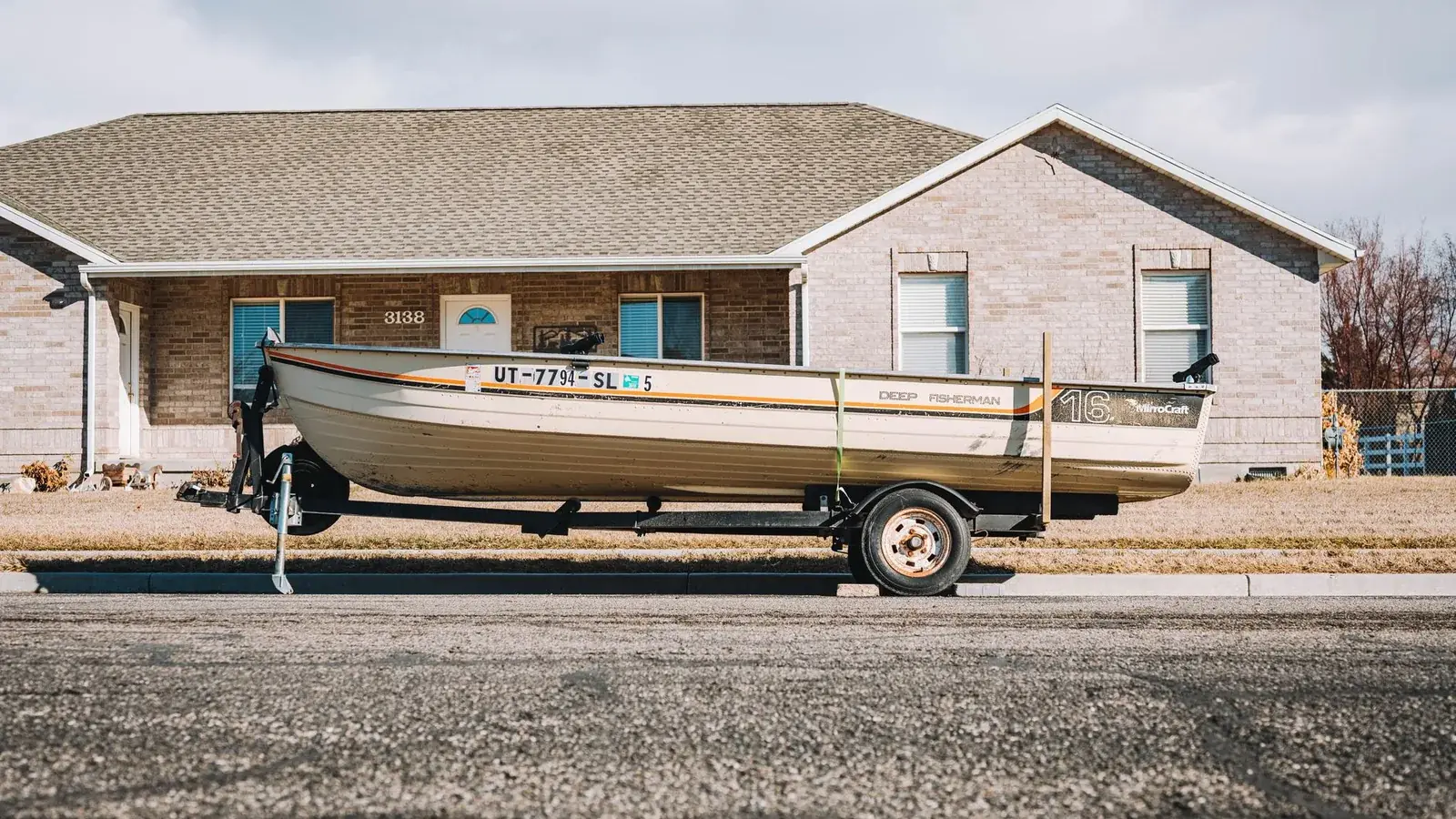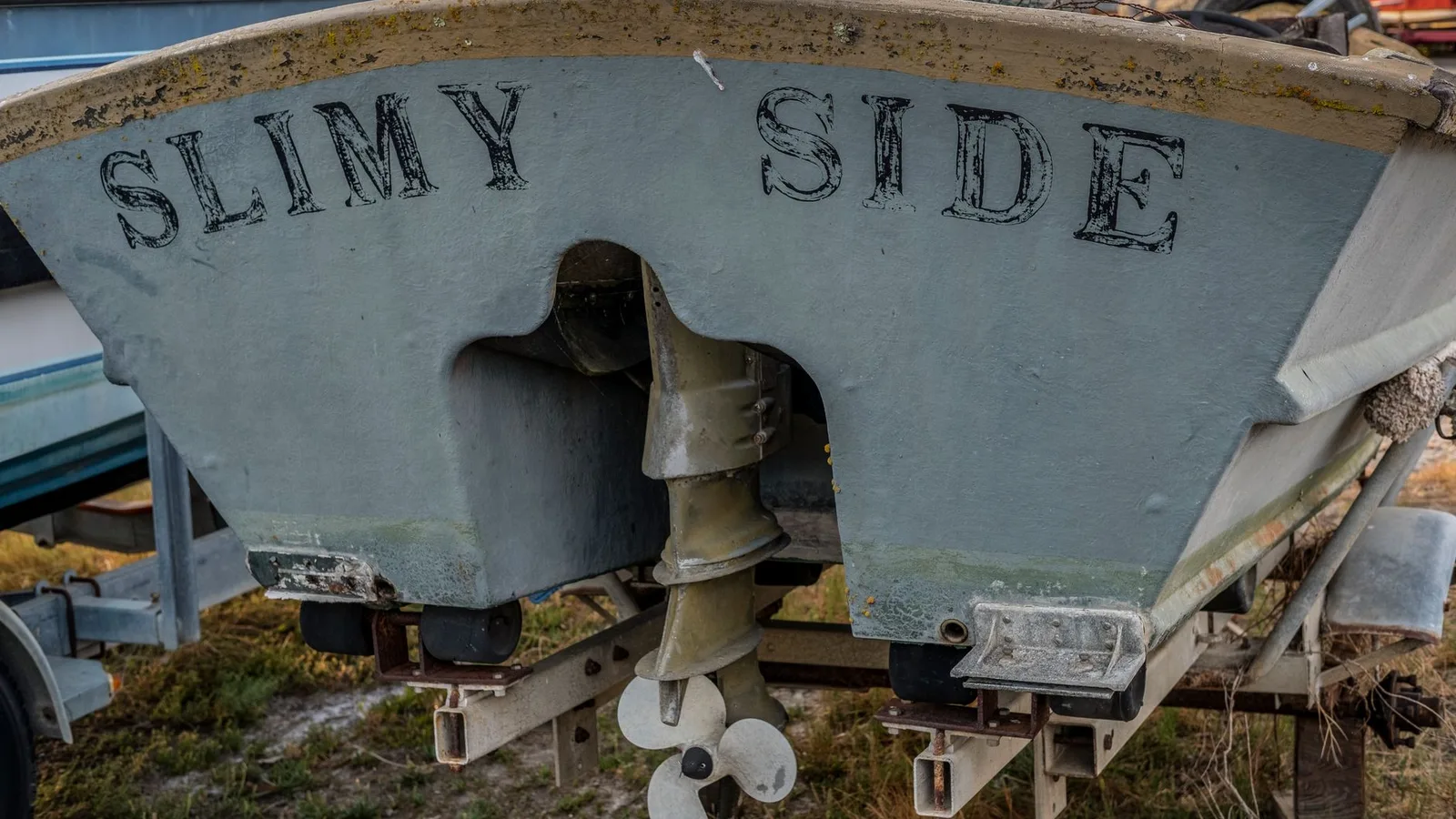
Nobody buys a boat for the trailer, which is exactly why the trailer is where the surprises live. It has sat outside for a decade while the boat was covered, it is the part the seller has never maintained, and it is the only part that can fail at seventy miles an hour with your new purchase on top of it.
First: is there one, and whose is it?
A trailer is worth $1,500 to $5,000 on its own, so "no trailer" changes the math on a listing immediately. It also creates a logistics problem that people underestimate. You cannot take the boat home. You are now renting, borrowing, or paying someone to haul it.
In most states the trailer carries its own title, separate from the boat. A seller saying "I have the title" may only be talking about one of them. Ask about both explicitly, and match the VIN on the trailer frame to the paperwork. The boat's own paperwork works the same way, and the checks for it sit in the walkthrough on inspecting the hull and engine. Which of the two documents your state actually issues is not the same question everywhere either, and the boat title rules state by state name the agency that decides it. If those two answers keep sliding around, treat that as the answer. Trailer paperwork that does not match the boat on it is one of the shapes that repeats on Marketplace, and asking for both titles in the seller's own name is the request that surfaces it.
How do you check trailer wheel bearings?
Wheel bearings are the most common trailer failure, and the most consequential. They live just behind the hub, they get dunked in water every time the boat is launched, and water plus grease plus heat is how bearings die.

Checking them takes two minutes per wheel:
- Jack the wheel clear of the ground.
- Grab it at twelve and six o'clock and rock it. Any noticeable play means the bearings are worn or loose.
- Spin it. It should turn freely and quietly. Grinding, rumbling or roughness means they are on the way out.
- Put a hand on the hub after a drive, if you get the chance. A hub much hotter than the others is a bearing about to fail.
Bearings are cheap. A bearing kit and an afternoon is a normal, expected job on any used trailer, and fitting bearing protectors afterwards keeps water out on future launches. What is not cheap is a hub seizing on the interstate and taking the spindle with it.
How old is too old for a trailer tire?
This is the check people get most wrong. Trailer tires often have beautiful tread and are still dangerous, because they have spent eight years in the sun barely turning. Rubber degrades with UV and time regardless of use.
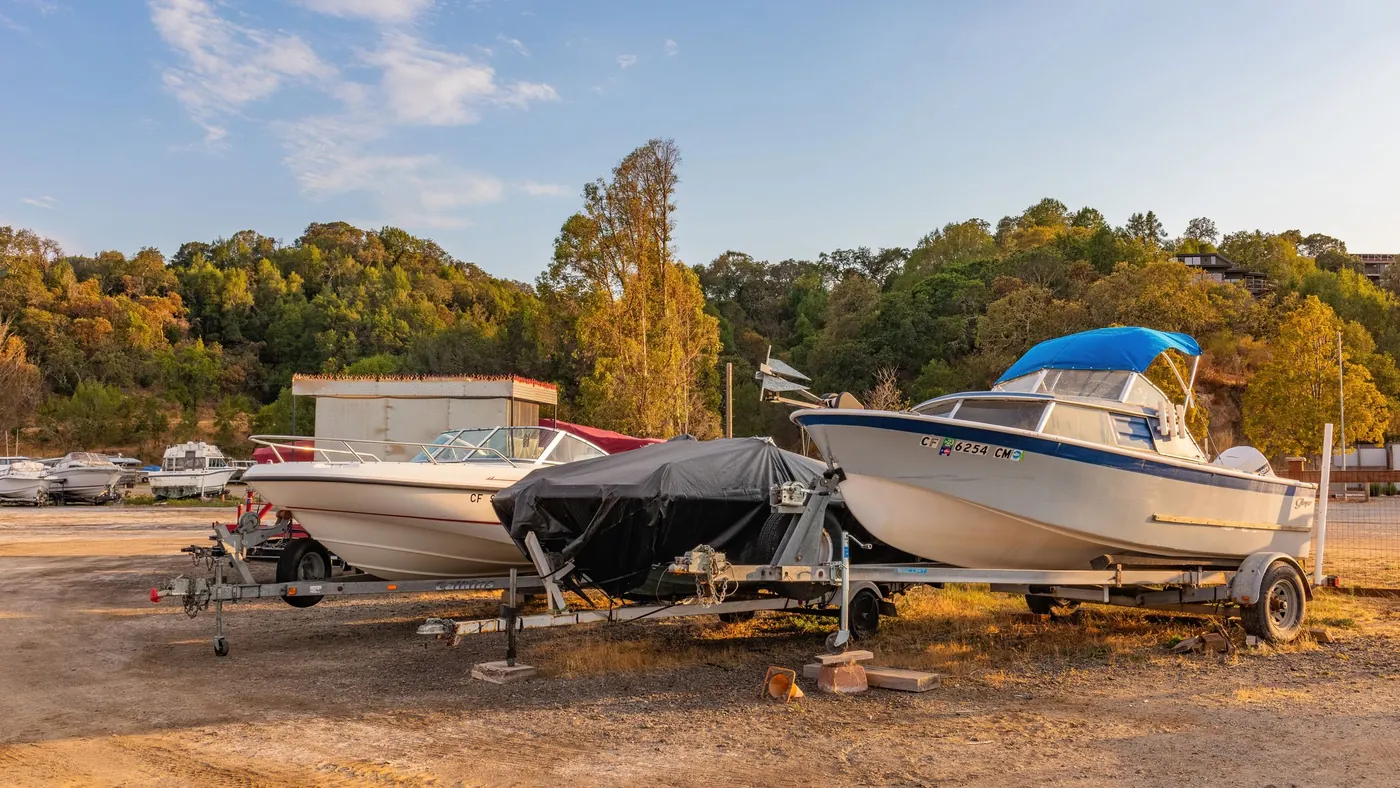
Find the DOT code on the sidewall. The last four digits are the week and year of manufacture, so 2419 means the 24th week of 2019 (NHTSA TireWise sets out the format, and notes that vehicle and tire manufacturers commonly call for replacement somewhere between six and ten years old regardless of tread). That window is for tires that spend their life rolling. A trailer tire parked in the sun between launches gets there sooner, which is why five or six years is the number most trailer guidance lands on. Also check:
- Sidewall cracking, especially in the grooves near the rim.
- Correct pressure, which on trailer tires is usually much higher than a car and printed on the sidewall. A pressure gauge lives in the truck for a reason.
- That there is a spare, that it holds air, and that you actually have a jack and a wrench that fit the trailer.
Bearings and tires are what a trailer looks like standing still. Neglect in either only announces itself under load, which is what the drive home actually asks of that trailer. Uneven bunks and a soft tire show up standing still, though: they are two of the reasons a boat can sit leaning to one side with nothing whatsoever wrong with the hull.
What is stamped on the trailer's capacity label?
This is the check almost nobody does, and it is the one that decides whether the trailer under the boat is legal to tow behind the truck you arrived in. Federal rules require a certification label on the forward half of the left side of a trailer, and they specify what has to be on it: the manufacturer, the month and year of manufacture, the Gross Vehicle Weight Rating, a Gross Axle Weight Rating for each axle, and the vehicle identification number (49 CFR 567.4).
Read three things off it. The GVWR is the most the trailer and its load may weigh together, so a 3,500 lb rating under a boat and motor that weigh 3,200 lb leaves you almost nothing for fuel and gear. The GAWR tells you whether a single axle is being asked to carry the lot. And the VIN is the number that has to match the trailer title the seller is offering you, which is the point where a lot of second-hand trailers quietly fall apart as a purchase.
A label that has corroded to nothing is common on a trailer that has spent fifteen years being dunked in salt water. It is not fatal, but it does mean the capacity numbers are now guesswork, and guesswork is a poor thing to be doing at seventy miles an hour.
What if the trailer lights do not work?
Bring someone, plug the trailer in, and have them work the brake pedal and indicators while you stand behind it. Trailer wiring lives in salt water and road spray, so corrosion is normal and a full harness replacement is a half day of unpleasant but simple work.
Know what you are counting before you start. Federal lighting rules for trailers (FMVSS 108, 49 CFR 571.108) call for taillamps, stop lamps, turn signals, a license plate lamp, side marker lamps and reflex reflectors, so a trailer that lights up at the back and shows nothing along its sides is missing equipment rather than passing.
If the lights are dead, check the ground first. On trailers it is nearly always the ground.
What should you check on the frame and welds?
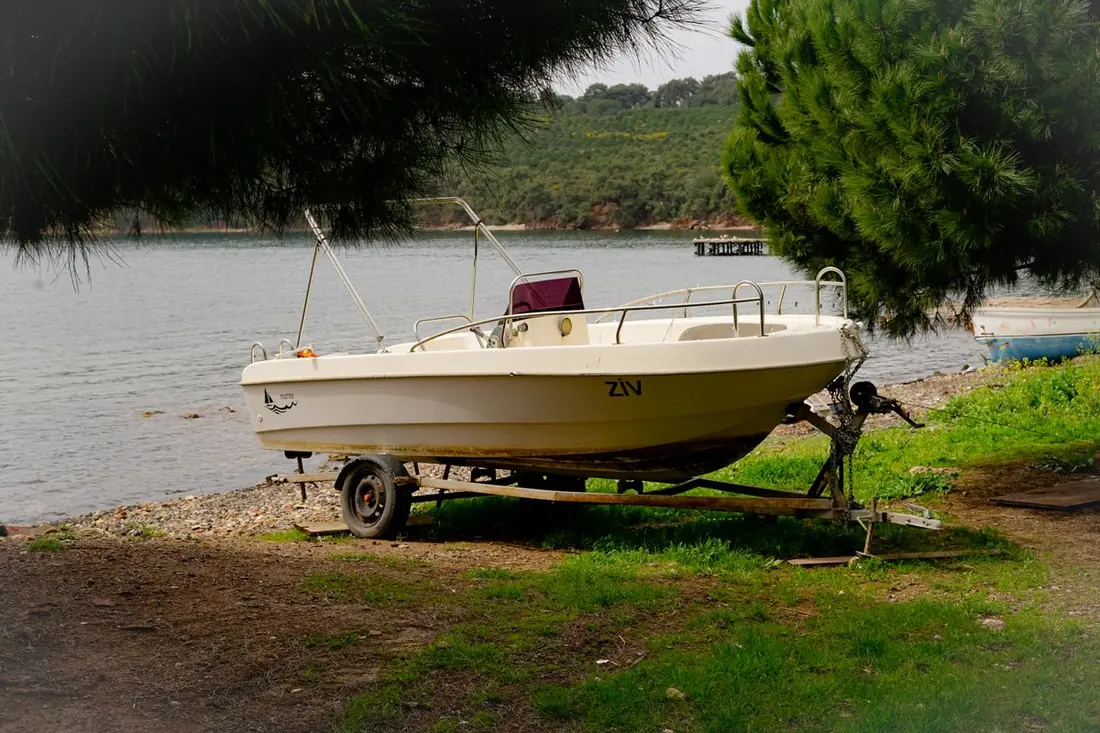
- Frame rust. Surface rust on a painted trailer is expected. Flaking scale, especially at the crossmembers and around the axle mounts, is structural.
- Welds at the tongue and crossmembers. Cracks there are a hard no.
- Rollers and bunks. Cracked rollers and rotten bunk carpet are cheap, but they tell you how the boat has been supported, and a badly supported hull can develop pressure marks.
- Winch strap. A frayed strap is a two-minute replacement and a good indicator of general care.
- Safety chains and coupler. The coupler should latch positively onto a ball of the right size, and the chains should exist and cross under the tongue.
- Tie-downs. If you are driving it home today you need transom straps that are not sun-rotted, whatever the seller has lying in the truck bed.
Does it have brakes, and do they still work?
Heavier rigs have surge or electric brakes, and they are frequently seized or disconnected on a trailer that has sat. Look for a surge coupler that moves freely, and ask directly whether the brakes work. This is one of the few areas where "I never really used them" is a genuinely common and genuinely honest answer.
What does each trailer finding cost?
The whole walkthrough in one place, with what a pass looks like and what a failure is worth. The cost column is the range a US trailer shop or parts supplier would typically quote as of August 2026, not a published price survey, so use it to decide whether to keep negotiating rather than as an estimate for the work.
| Part | Check | Pass looks like | Failure costs |
|---|---|---|---|
| Wheel bearings | Rock and spin each wheel, hub temperature after a drive | No play, spins quiet, hubs all the same warmth | Bearing kit and an afternoon; a seized hub takes the spindle with it |
| Tires | DOT date code on the sidewall, not tread depth | Under five or six years since the code week | A few hundred for a set |
| Capacity label | GVWR, GAWR and VIN, forward half of the left side | Present, legible, GVWR comfortably above boat plus gear | No label means no capacity numbers and no VIN to match the title against |
| Lights and wiring | Plug it in, work the brake pedal and indicators | Stop, tail, turn, plate and side markers all answer | Harness replacement, half a day and parts money |
| Frame and welds | Crossmembers, axle mounts, tongue | Surface rust only, no cracks at the welds | Flaking scale or a cracked tongue weld is a walk-away |
| Coupler and chains | Ball size stamped on the coupler, chains crossed under the tongue | Latches positively, chains present and rated | Parts money, and a citation if you tow it as found |
| Brakes, if fitted | Surge coupler movement, or the electric controller | Actuates and releases | Seized actuator or a disconnected line, parts and labor |
| Bunks and rollers | Carpet condition, cracked rollers, how the hull sits | Hull supported evenly along its length | Cheap to replace, but pressure marks in the hull are not |
| Trailer title | A separate document from the boat's, VIN matched to the frame | Present, in the seller's name, numbers agree | A delay and a discount, or a walk-away |
The first two rows are the ones that fail on the road. The last row is the one that fails in a government office six weeks later, and it is covered properly in what "no title" actually means when you buy a used boat.
What this is worth at the negotiation
Bearings, tires, a harness and straps together are a few hundred dollars and a weekend. That is not a reason to walk away, it is a reason to say a number. Sellers who have not thought about the trailer at all are usually the ones who will move on price when you list what it needs.
The same arithmetic runs on the boat itself, and it runs in bigger numbers: the listing phrases that cost real money puts a figure against each one so you know which findings are a discount and which are a walk-away. Anything else we write on the subject gets filed with the boat trailer guides alongside this one.
Check the current price before you buy any of it
Prices on all of the above move around, so treat the links as a starting point for what the thing is rather than what it costs today.
Cite this page
The cost ranges above are what a US trailer shop or parts supplier typically quotes for each job, not a published price survey, and parts and labor both move a long way between markets, so treat them as negotiating context rather than an estimate for the work. Last checked August 20, 2026. The certification label contents and the required lamps and reflectors are federal requirements and are cited inline to 49 CFR 567.4 and FMVSS 108 respectively; the tire date code format and the six to ten year replacement window are NHTSA's.
You may republish these figures with attribution and a link to https://docksnipe.com/blog/boat-trailer-checks-before-you-buy.